Chenago County Dog Registration Information
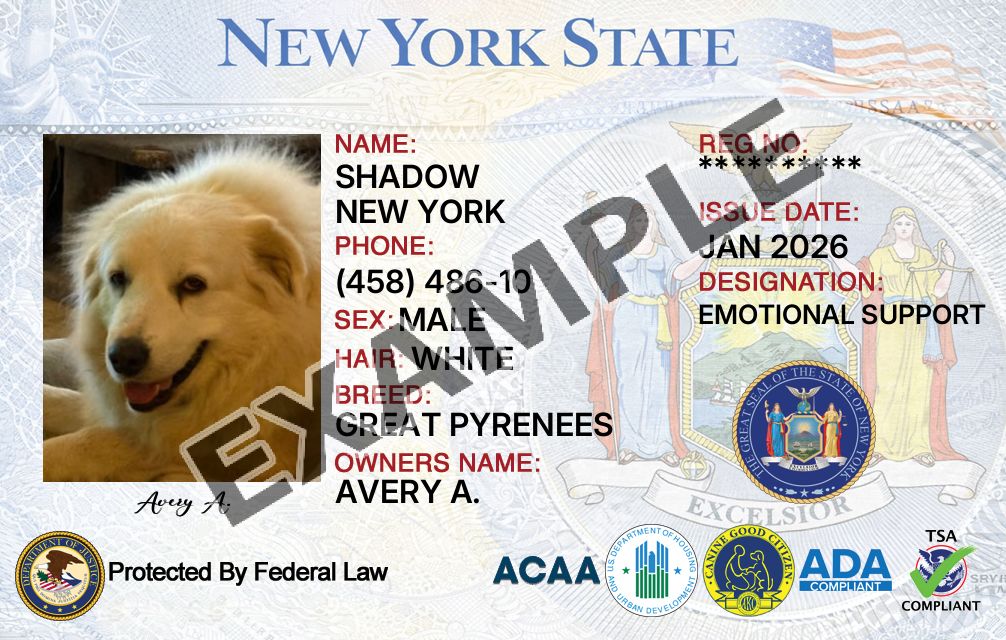
Service Dogs and Emotional Support Animals in Chenago, New York
If you’re searching “where do I register my dog in Chenago County, New York for my service dog or emotional support dog,” the key point is that most “registration” in New York is handled as a local dog license through your city, town, or village (not through a single statewide or federal service-dog registry). In Chenango County, dog licensing typically happens at the municipal clerk’s office where you live (for example, the City of Norwich Clerk/Finance Office for city residents), while the County Public Health Environmental Health division supports animal-related public health functions such as rabies information and investigations.
- There is no single universal federal “service dog registry” that you must use for a service dog.
- Emotional support animals are not “registered” through a government registry either; ESAs are typically supported by documentation for housing (and sometimes other limited contexts).
- Dog licensing is still commonly required for dogs kept in a municipality, and you’ll usually need proof of rabies vaccination.
Where to Register or License Your Dog in Chenago County, New York
The offices below are official government contacts that serve Chenango County residents. Which office you should use depends on whether you live inside a city (such as the City of Norwich) or in a town/village elsewhere in Chenango County. If you are unsure which municipality you are in, call the county Environmental Health number below and ask where your address should be licensed.
Chenango County Public Health Department — Environmental Health
This office is a reliable starting point for countywide animal-related public health questions (including rabies guidance) and can help direct you to the correct municipal licensing office for your specific address.
City of Norwich — Clerk’s Office / Finance Department (Dog Licensing)
Use this office if your dog is housed within the City of Norwich limits (city residents). The city notes that a licensing ordinance is in place and that licensing information is available through the Finance Department.
Town of Norwich — Town Clerk (Municipal Office Contact)
This is a municipal contact for Town of Norwich residents (outside the City of Norwich). Dog licensing in New York is often handled at the municipal clerk level; if you’re in the town (not the city), call the Town Clerk to confirm the licensing process for your address.
Overview of Dog Licensing in Chenago County, New York
How licensing typically works
In Chenango County, New York, dog licensing is generally a municipal responsibility (your city, town, or village). That means the correct place to get a dog license in Chenago County, New York depends on exactly where you live—for example, city residents often license through the city clerk/finance office, while town and village residents may license through the town or village clerk.
The county’s Environmental Health office supports public health activities related to animals (including rabies investigations and information), and it’s also a practical starting point if you’re not sure which local office handles your dog license.
Why the terms “register” and “license” get mixed up
Many people say “register my dog,” but what most local governments require is a dog license. A dog license is typically a record in your municipality plus a tag you can attach to your dog’s collar. Service dog status or emotional support animal status is handled differently than licensing (explained below), but licensing requirements may still apply in many municipalities.
What You Need Before Registering a Dog
Common documents and information
While dog licensing requirements can vary by municipality within Chenango County, New York, many offices ask for similar items. Having these ready can make the process smoother:
- Current rabies vaccination certificate (often required to issue or renew a dog license)
- Spay/neuter certificate (if applicable; may affect the licensing fee)
- Your identification and contact information
- Proof of residence in the municipality (sometimes requested)
- Payment for the licensing fee (amount and accepted payment types can vary)
Rabies vaccination is a frequent “must-have” item
Local licensing offices commonly require a valid rabies certificate to license a dog. If your rabies certificate is expired or you can’t locate it, contact your veterinarian for a copy before you try to complete licensing.
Steps to Register or License a Dog in Chenago County, New York
Step 1: Identify your municipality (city vs. town/village)
Start by confirming whether your home address is inside a city limit (such as the City of Norwich) or in a town/village area. This matters because your dog license is usually issued by the municipality where the dog is housed.
- If you live within the City of Norwich, contact the City Clerk/Finance Department listed above.
- If you live in a town or village within Chenango County, contact your local town or village clerk. If you are unsure, start with Chenango County Environmental Health and ask where your address should be licensed.
Step 2: Gather required proof (rabies + any applicable spay/neuter documentation)
Most dog licensing requirements in Chenago County, New York include proof of current rabies vaccination. Some municipalities also ask for spay/neuter documentation or additional prior-license information if you’re transferring from another area.
Step 3: Apply for a new license or renew an existing license
Depending on the office, you may be able to apply in person and/or by submitting a form. When you receive your license, you should also receive (or be able to request) a tag to attach to your dog’s collar.
Step 4: Keep your records organized for housing, travel, and renewals
Keep copies (paper or digital) of your dog’s rabies certificate, license receipt, and any spay/neuter documentation. If your dog is a service dog or emotional support animal, keep the relevant documentation for the specific context (for example, housing requests for an ESA) separate from licensing records.
Service Dog Laws in Chenago County, New York
Service dogs are defined by training and disability-related work
A service dog is generally a dog that is individually trained to do work or perform tasks for a person with a disability. The legal status is based on the dog’s training and the handler’s disability-related need—not on a government-issued “service dog registration number.”
Licensing vs. service-dog status
A dog license in Chenago County, New York (or in your municipality) is a local administrative requirement. Service dog status is a separate legal concept. In practice, you may still be asked to comply with local dog licensing requirements (such as keeping rabies proof on file), even if your dog is a service dog.
What offices can (and cannot) do
- Municipal licensing offices can issue dog licenses and tags according to local rules and the documentation they require (often rabies proof).
- They generally do not “certify” a dog as a service dog the way people sometimes expect, because service dog status is not created by a single universal registry.
Emotional Support Animal Rules in Chenago County, New York
ESAs are not the same as service dogs
An emotional support animal (ESA) is generally an animal that provides comfort by its presence and may be supported by documentation for specific legal contexts (most commonly housing). ESAs are not the same as service dogs because they are not necessarily trained to perform disability-related tasks.
Licensing still matters
Even if your dog is an ESA, local rules may still require a dog license in Chenago County, New York through your city/town/village, along with proof of rabies vaccination. ESA documentation is usually separate from the licensing process and does not replace vaccination or local licensing requirements.
Dog License vs. Service Dog vs. Emotional Support Animal (Comparison)
| Category | Dog License | Service Dog | Emotional Support Animal (ESA) |
|---|---|---|---|
| What it is | A local municipal license/record for a dog housed in a city/town/village. | A dog individually trained to perform tasks or work for a person with a disability. | An animal that provides emotional support/comfort; typically relevant in housing contexts. |
| Who issues it | Your city/town/village clerk or licensing office (varies within Chenango County, NY). | No single government registry creates service-dog status; status is based on training and disability-related need. | No single government registry; status is typically supported by documentation for a specific request (commonly housing). |
| Common documentation | Rabies vaccination certificate; may also request spay/neuter proof and identification. | Training evidence is not usually “filed” with a county; access questions focus on the dog’s behavior and task training. | Documentation supporting need for an ESA in a particular context (often housing); not a “license tag.” |
| Does it replace licensing? | Not applicable. | No. A service dog may still need a local dog license, depending on municipal rules. | No. An ESA may still need a local dog license, depending on municipal rules. |
| Where to start in Chenango County, NY | Contact your municipality (City of Norwich Clerk/Finance if in the city; otherwise your town/village clerk). | Start with local licensing for the dog license portion; service-dog legal status is separate from licensing. | Start with local licensing for the dog license portion; ESA documentation is typically handled through the specific setting (often housing). |
If you’re looking for “animal control dog license Chenago County, New York,” keep in mind that animal control/dog control functions and dog licensing often intersect, but the license itself is commonly issued by the municipal clerk, not by a private registry or a universal federal program.
Frequently Asked Questions
Do I have to license a service dog in Chenago County, New York?
Many municipalities require a dog license for dogs housed in their jurisdiction, and licensing commonly requires a rabies certificate. Because requirements can vary by municipality within Chenango County, contact your local clerk’s office (or the county Environmental Health office to be directed to the correct municipal office) and ask what documentation is needed for your situation.
Where do I register a dog in Chenago County, New York if I’m not in the City of Norwich?
If you are outside the City of Norwich, you will generally start with the town or village clerk for the municipality where your dog is housed. If you’re unsure which municipality you fall under, call Chenango County Public Health Environmental Health at 607-337-1673 and ask which local office handles dog licensing for your address.
Do emotional support animals have a special county registration?
Not typically. ESAs are usually not “registered” through a government registry. The most common administrative step that looks like “registration” is still the local dog license (if required by your municipality), plus keeping your rabies documentation current.
What proof do I usually need for dog licensing requirements in Chenago County, New York?
Many offices ask for a current rabies certificate and may ask for spay/neuter documentation if applicable. Some areas may also request identification, proof of residency, or a prior license number if you are transferring or renewing.
Register A Dog In Other New York Counties
Select your county below to get started with your dog’s ID card. Requirements and license designs may vary by county, so choose your location to see the correct options and complete your pup’s registration.
- Albany County Dog Registration
- Allegany County Dog Registration
- Bronx County County Dog Registration
- Broome County Dog Registration
- Cattaraugus County Dog Registration
- Cayuga County Dog Registration
- Chautauqua County Dog Registration
- Chemung County Dog Registration
- Clinton County Dog Registration
- Columbia County Dog Registration
- consolidated borough-county government County Dog Registration
- Cortland County Dog Registration
- Delaware County Dog Registration
- Dutchess County Dog Registration
- Erie County Dog Registration
- Essex County Dog Registration
- Franklin County Dog Registration
- Fulton County Dog Registration
- Genesee County Dog Registration
- Greene County Dog Registration
- Hamilton County Dog Registration
- Herkimer County Dog Registration
- Jefferson County Dog Registration
- Kings County County Dog Registration
- Lewis County Dog Registration
- Livingston County Dog Registration
- Madison County Dog Registration
- Monroe County Dog Registration
- Montgomery County Dog Registration
- Nassau County Dog Registration
- New York County County Dog Registration
- Niagara County Dog Registration
- Oneida County Dog Registration
- Onondaga County Dog Registration
- Ontario County Dog Registration
- Orange County Dog Registration
- Orleans County Dog Registration
- Oswego County Dog Registration
- Otsego County Dog Registration
- Putnam County Dog Registration
- Queens County County Dog Registration
- Rensselaer County Dog Registration
- Richmond County Dog Registration
- Rockland County Dog Registration
- Saratoga County Dog Registration
- Schenectady County Dog Registration
- Schoharie County Dog Registration
- Schuyler County Dog Registration
- Seneca County Dog Registration
- St. Lawrence County Dog Registration
- Steuben County Dog Registration
- Suffolk County Dog Registration
- Sullivan County Dog Registration
- Tioga County Dog Registration
- Tompkins County Dog Registration
- Ulster County Dog Registration
- Warren County Dog Registration
- Washington County Dog Registration
- Wayne County Dog Registration
- Westchester County Dog Registration
- Wyoming County Dog Registration
- Yates County Dog Registration